
A Comprehensive Solution for Tooth Replacement
Screwless dental implants are some of the latest advancements in dental restoration technology and employ a high-precision locking taper interface to attach the abutment to the implant fixture as opposed to mechanical screws. These friction-based interfaces eliminate the most prevalent modes of failure in dentistry – the loosening of and fracture of the screw – while providing a hermetic seal to prevent bacteria from entering the jawbone and creating infection.
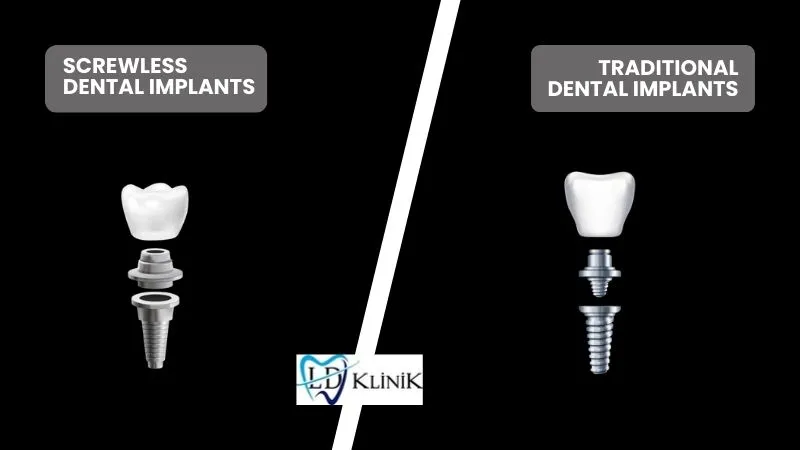
These advanced systems replace the threaded connections found in standard implants with a "cold-welded" interface, which provides for a more biologically stable and durable method of restoring smiles. Therefore, they address the engineering deficiencies in standard implants and provide for both long-term structural integrity and biological health of the tissues surrounding the implant site.
The concept behind Antalya screwless implants is eliminating the weakest link in the implant system. Standard implants rely upon a screw to connect the abutment to the implant fixture. However, when a patient chews a hard object or grinds their teeth, the screw will flex. When the screw continues to flex over time, the screw may begin to loosen. Screwless implants remove the screw from the connecting interface to address this issue.
Instead of using threads and screwdrivers to create a connection, these systems employ a "locking taper." Think about stacking two paper cups together. If you apply gentle pressure and then try to separate them, they may remain connected. However, if you apply sufficient pressure and the angle of the cups match each other perfectly, they will lock together and cannot be separated easily. This is essentially how the connection works, but rather than being made out of plastic, it is made from medical grade titanium.
The connection is extremely stable due to the lack of a screw to vibrate loose and allow the tooth to move. There are several advantages to the stability of this connection. First, because the parts fit together so tightly, it creates a seal to block bacteria from entering the jawbone. One of the biggest concerns with older screw-based systems was the potential for a small gap to exist between the two parts of the system. While this gap was small enough that the eye could not detect it, it was large enough for bacteria to enter through and create infection within the bone. The screwless design seals this gap completely.
A second interpretation of "screwless" relates to the implant itself, i.e., the part that is inserted into the jawbone. Traditional implants resemble the screws available at a local hardware store and are screwed into the bone via their threaded design. True screwless implants typically appear different. They lack the threaded design. Rather than twisting the implant into the bone, a series of fins or shelves are pressed or tapped into a prepared area of bone. The fins instantly secure the implant to the bone, similar to a wall anchor that expands to securely grasp the surrounding material.
The first key is the connection referred to as "cold welding" previously. When the dentist drives the solid post into the well of the implant, he uses a tremendous amount of force. The angle of the post is a perfect match for the angle of the well. Due to the extremely high friction caused when the post slides into the well, the surface layer of the metal molecules scrape off and the underlying metal fuses.
Therefore, the two components of the connection will effectively be an integral single piece of metal, with zero give or play. The "pumping" effect caused by the chewing motion of a screw-implant, where the gap between the screw head and the bone opening and closing repeatedly, allowing saliva and bacteria to move into the bone, does not occur with cold-welding (hermetic seal).
The second key is the shape of implant body. As previously discussed, the design of the fins or shelves of the implant body is critical to maintaining the health of the bone. Traditional threaded screw implants remain secure by damaging the bone slightly to create pressure. The finned design is much more passive in nature. It fits into the hole of the bone, and the fins provide a massive amount of surface area – far greater than a standard screw.
Due to the space created by the fins, your body is able to rapidly produce new bone growth within those spaces. The bone produced in those spaces is generally healthier and matures much faster than the bone attempting to heal around the tightly wound threads of a standard screw. The rapid bone regeneration and large surface area available with the finned design allows for the use of significantly shorter implants than were previously possible.
Implants do not require any special care. The most important part is your daily dental care routine and cleaning the gum line with dental floss. In addition, going for annual dental checkups and having professional cleanings ensures that your implants remain well-maintained and healthy for many years.
The major risk factor associated with screwless dental implants is biological — primarily gum infection. Gum infection is the number one cause of failed implants. This is typically related to a patient's lifestyle and/or health condition(s).
There are several key risk factors that contribute to gum infections — including: Smoking, diabetes, poor hygiene.
Lastly, there is the issue of removal. Unlike screw-type implants which can simply be unscrewed and removed, screwless implants are much more difficult to remove as they are cold-welded together. As such, we frequently need to cut the crown off or use specialised vibration tools to create an opening to remove the broken abutment. Removal is certainly possible, but it requires more effort than removing a screw.
The primary difference is the method of connection and sealing. Traditional implants work like a nut and bolt. There is a threaded hole in the post, and you torque a screw into that hole to secure the tooth. Screwless implants operate in a similar way to how a cork works in a wine bottle, but is made of metal. Once pressed together, friction creates an unbreakable seal. The differences in the two types of implants can be summarized as follows: Type of connection, seal of bacteria, stability of components.
Screwless implants seal the gap where bacteria can enter and exit the implant space with each chew, while traditional implants have a microscopic gap that allows bacteria to pass through. Screwless implants tighten with each use, while traditional screws loosen over time. Finally, aesthetically speaking, screwless teeth appear more natural because there is no plug screwed into the biting surface of the tooth.
This blog is written for informational purposes only and is not intended for treatment. If you would like to make an appointment at our Antalya clinic, LD Clinic, please contact us.