
A Comprehensive Solution for Tooth Replacement
Zirconia crowns are known for lasting long, and the clinical data supports that. Studies report that monolithic zirconia crowns can reach around 98% survival at 5 years, which is a very strong result for any dental restoration.
But here’s the key point. When something does go wrong, it’s usually not the zirconia itself. It’s things like the bonding, the gum condition, or the tooth underneath.
So, the real question is not just 'how long does zirconia last?' It’s what actually affects that lifespan. Let’s break that down step by step in this article.
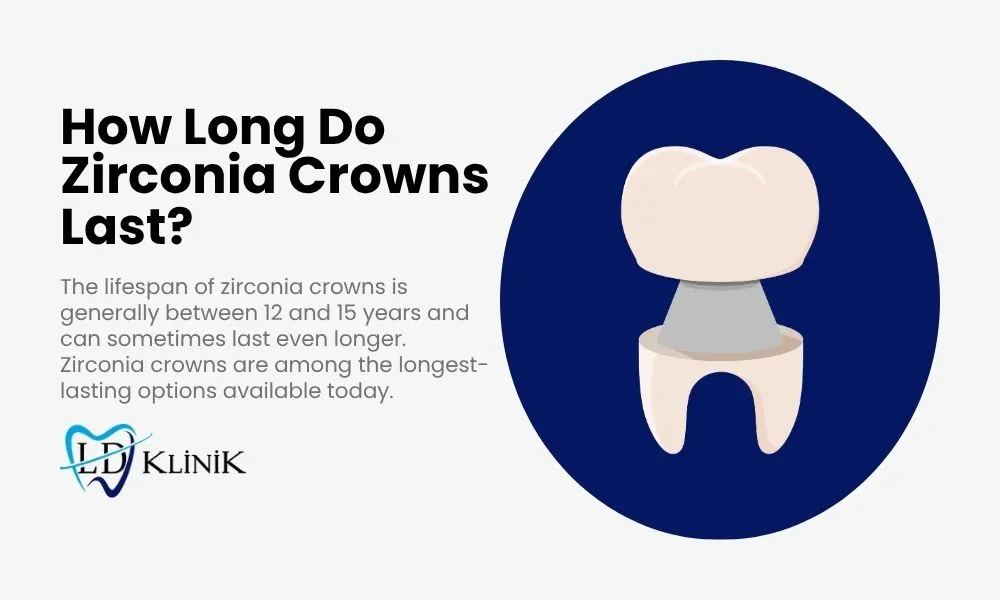
If we strip it down to numbers, most zirconia crowns last somewhere between 12 and 15 years, sometimes even longer. Zirconia crowns are actually among the longest-lasting options we have today.
But honestly, focusing only on 'years' can be misleading. Because the crown itself is rarely the weak point. The material itself has very high flexural strength, often reported between 900 to 1200 MPa, which is significantly higher than many traditional ceramic systems. That’s why fractures are actually rare.
What determines how long it lasts is:
If these are under control, the crown can easily outlast expectations. If not, even the best zirconia will fail earlier than it should.
This is where things get more nuanced. Two patients, same crown, completely different outcomes. The difference comes from these factors.
The internal structure of the crown changes how it behaves over time.
Monolithic zirconia
is milled from a single block. There is noMonolithic zirconia crown Antalya layering, no interface between materials. This matters because interfaces are weak points. When you remove that interface, you remove a common failure mechanism.
Monolithic zirconia means:
That’s why these crowns are often chosen for molars or patients with strong bite forces. Because they are built for durability.
Porcelain-coated zirconia
This type is basically a mix of strength and aesthetics. You have a solid zirconia core underneath, which gives the crown its durability. Then on top of that, a layer of porcelain is added to make it look more natural. That outer layer is what gives the crown that lifelike translucency, the way light passes through it, just like a real tooth.
So visually, these crowns look great. Especially in the front teeth, where appearance really matters. Honestly, when done well, you can’t tell the difference. But here’s the trade-off, and I always explain this clearly.
That porcelain layer is not as strong as zirconia. It’s more delicate. So over time, especially if the patient has a strong bite or grinds their teeth, small chips can happen.
Clinically, this is one of the more common problems we see with layered zirconia. The core stays intact, but the outer layer can wear or chip under repeated stress. So, you’re choosing between two things here. Better aesthetics or maximum durability.
For front teeth, this option makes a lot of sense. For back teeth, especially in patients with heavy bite forces, we tend to be more cautious.
This part is actually more important than most people think. For a zirconium crown to bond properly, the surface needs to be prepared in a specific way. Usually, we roughen it with air abrasion to create micro-retention. Then we use special primers, most commonly ones containing MDP, which can chemically bond to zirconia.
Now here’s the key point. If this protocol is not followed correctly, the crown can work fine at first. It sits well, looks perfect, no issues. But over time, that weak bond can start to fail. The crown doesn’t break. it simply loses retention.
Also, bonding is not just about chemistry. The shape of the prepared tooth matters a lot. If the tooth is too short or too tapered, even a good cement won’t fully compensate for the lack of mechanical grip.
This is one of those details that looks small but changes everything.
Occlusion simply means how your teeth meet when you bite. If that contact is not balanced, even slightly, the crown can end up receiving more force than it should.
At first, you may feel normal. But over time, that extra pressure builds up in one spot. And that’s where problems start. Not suddenly, but slowly.
What we usually see in poorly adjusted bites is stress on the cement layer, tiny movements you can’t notice, and sometimes wear on the opposing tooth.
When the bite is adjusted correctly, the load spreads evenly. The crown becomes part of the system, not a pressure point.
Teeth grinding is one of those things people don’t notice… but it quietly causes damage over time. When you eat, your teeth touch for a few seconds and then relax. But when you grind, especially at night, your teeth stay under pressure for much longer. And that pressure keeps repeating.
Zirconia crown is strong, yes. But even strong materials don’t like constant stress. Over time, grinding can weaken the bond, strain the tooth underneath, and even wear down the opposite teeth.
The tricky part is, most people don’t know they grind until we point it out.
That’s why we often suggest a night guard. It’s simple, but it protects both the crown and your natural teeth from that continuous pressure.
Gum recession is something that happens slowly… most people don’t notice it at first. As the gum line moves down, the edge of the crown starts to show. And once that area is exposed, it becomes easier for bacteria to settle there. Over time, this can lead to decay right under the crown. And that’s usually when we have to change it, not because the zirconia broke, but because the tooth underneath is affected.
Clinically, we do see this. For example, studies show that around 20 percent of zirconia crown cases can present mild gum recession (less than 2 mm) over time, even when everything is done properly The good part is, zirconia is very well tolerated by the gums. When everything is done properly, the gum usually stays stable for years.
So really, it comes down to this. If the gums stay healthy, the crown stays with you longer.
A zirconia crown is only as good as the hands that make it. Two crowns can use the same material, but if one is prepared and placed better, it will last much longer. Things like how the tooth is shaped, where the margin is placed, and how accurately the crown fits… these are all decisions the dentist makes. And small differences here can turn into big problems over time.
A well-done crown just 'sits right.' You feel well, it doesn’t trap bacteria, and holds its position for years.
Oral care is the part you control and it makes a bigger difference than people think. A zirconia crown doesn’t decay, but the tooth underneath still can. If plaque builds up around the edges, bacteria slowly start affecting that area. At first, nothing goes wrong… then one day, there’s a problem under the crown. Brushing properly, using floss, and showing up for check-ups keeps that area clean and stable.
So, simple logic.
Clean mouth, longer-lasting crown.
What you eat every day has a quiet effect on how long a crown lasts. Zirconia is strong, so normal eating is not an issue. But habits repeated over time matter. Constantly chewing very hard things, like ice or hard nuts, puts extra pressure on the crown again and again. It does not break it right away, but it can create stress over the years.
Acidic drinks are another point. Beverages like soda or citrus lower the pH in the mouth. Zirconia itself is not affected much, but the tooth around it is. That area becomes more sensitive to damage, and the edge of the crown becomes harder to keep stable.
Sugar also plays a role. When sugar is taken often, bacteria around the crown margins increase. And problems usually start right there, at the edge, not on the crown itself. You do not need to avoid everything. Just keeping things balanced and not repeating harmful habits too often makes a difference.
Please contact LD Clinic for detailed information and a personalised treatment plan with pricing.